Arcade games should have disappeared years ago. Their original business model was built around something that no longer exists: access to video games as a scarce commodity. In the late 1970s and throughout the 1980s, arcade machines offered graphics, sound and gameplay that most people could not reproduce at home. Players paid for a few minutes of entertainment, competed for high scores and returned with another coin when their game ended. Today, even inexpensive smartphones can run games infinitely more sophisticated than the original Pac-Man, Space Invaders or Donkey Kong. Yet arcade cabinets remain surprisingly attractive, particularly in gaming museums, entertainment venues, retro bars and dedicated arcade spaces.
The photograph accompanying this article captures something that explains their enduring appeal. Several visitors stand shoulder to shoulder in front of classic arcade cabinets, surrounded by intense red, purple and orange lighting. One person concentrates on Space Invaders, another explores Pac-Man, while a third plays Donkey Kong. The players are physically together, but each is absorbed in a different game. There are no elaborate gaming chairs, expensive monitors or headsets isolating them from the room. The machines themselves become meeting points, and the experience is as much about being there as it is about winning.
Arcade games have survived because their value has shifted from technological superiority to something considerably harder to reproduce at home: immediate entertainment, physical interaction, social presence and the pleasure of playing a game that needs almost no explanation.
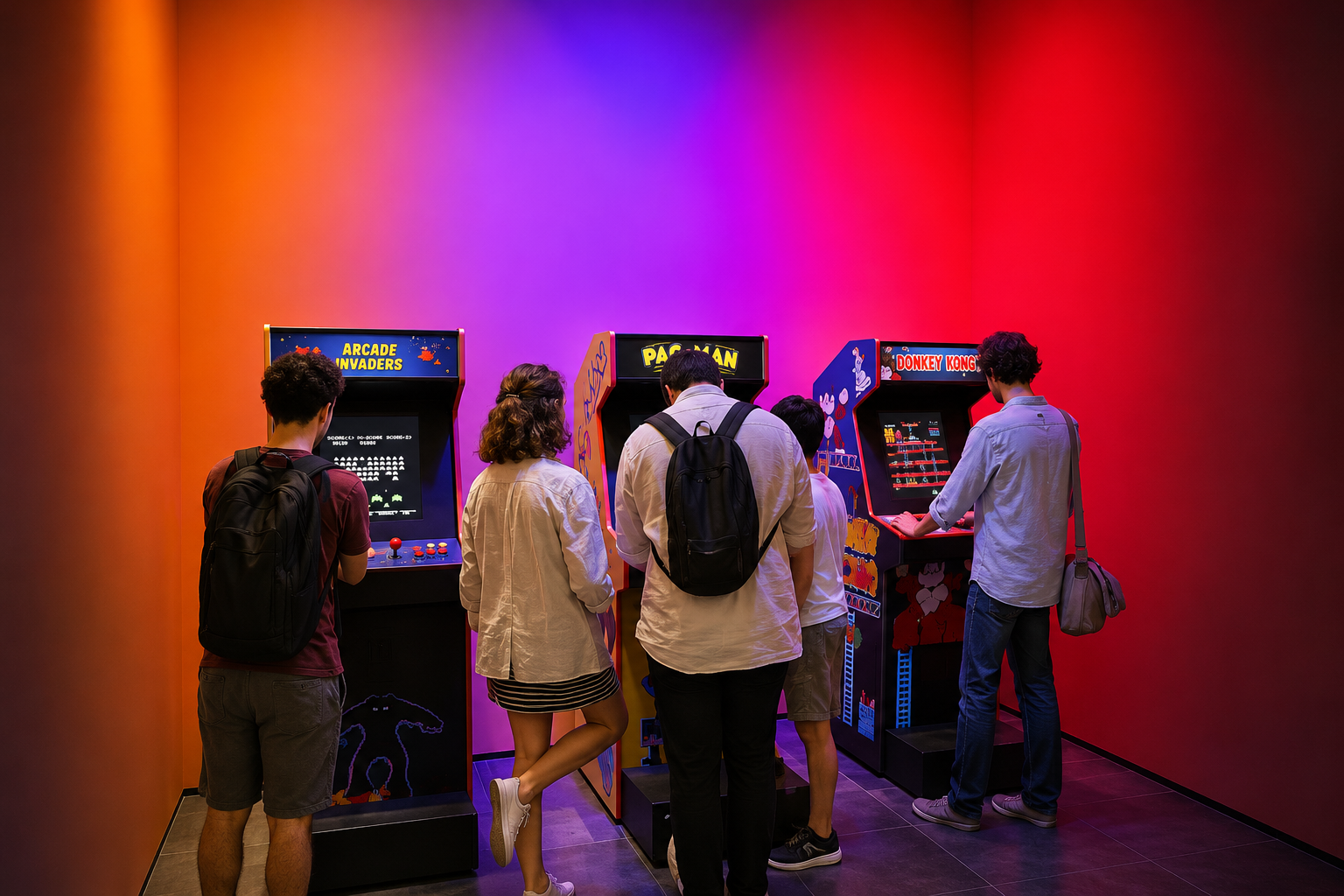
The simplicity is deceptive. A good arcade game communicates its rules almost instantly: move left, avoid the enemy, jump over the obstacle, eat the dots. Players do not need an account, a tutorial, a software update or a lengthy introduction to a fictional universe. They can begin within seconds, fail, laugh and try again. The controls are limited, but that limitation creates clarity. Every action matters, and a short session can feel complete rather than like the opening chapter of an endless commitment.
Classic cabinets also offer a distinctive physical interface. A joystick has resistance, buttons make a sound, and the player’s body moves in response to the action. The artwork on the cabinet, the glowing marquee and the arrangement of machines in a room contribute to the experience before the game even starts. Emulation can reproduce the software remarkably well, but playing the same game on a phone touchscreen is not quite the same thing as standing in front of the original-style machine.
Then there is the social dimension. Modern online games connect enormous numbers of players, but their interactions are often mediated through voice chat, matchmaking systems and digital avatars. In an arcade, someone can watch a stranger attempt a difficult level, offer advice or challenge a friend without arranging anything in advance. Spectators become part of the atmosphere. Even a single-player cabinet is not necessarily a solitary experience when others are standing nearby.
Nostalgia certainly helps, although it does not explain everything. Older visitors may recognize the games from childhood, but younger players often approach the same machines without personal memories of their original release. For them, pixel graphics, simple sound effects and cabinet artwork can feel fresh precisely because they differ from the dominant aesthetics of contemporary gaming. Retro games have become cultural objects, not merely outdated products.
Arcade design also benefits from a useful constraint: a game must be engaging immediately. Traditional coin-operated machines had to attract passersby and communicate excitement in a noisy room. That encouraged striking visuals, recognizable characters, short feedback loops and carefully tuned difficulty. Not every arcade game was fair, of course; some were designed to consume credits quickly. But the best examples achieved an economy of design that modern developers still study.
The commercial picture is more complicated than nostalgia suggests. The traditional neighborhood arcade, dependent on rows of coin-operated video games, faces a very different market from a family entertainment center with redemption machines, racing simulators, rhythm games and food service. Classic cabinets can work particularly well as part of a broader venue where admission, events, hospitality or group experiences contribute to revenue. Their role may be to attract visitors and give a place character rather than maximize revenue per machine.
This distinction matters to the gaming industry. The arcade is no longer primarily competing with home hardware on processing power or visual realism. It is competing in the experience economy, where people pay to do something memorable outside the home. A retro cabinet can function as entertainment, interactive history, interior design and a social catalyst at the same time. That combination is difficult to measure through conventional software sales figures.
Arcade culture also creates opportunities for game preservation. Cabinets, controls, artwork and original display technologies are part of gaming history, and keeping them playable allows visitors to understand how design evolved. A game that looks primitive in a screenshot can become unexpectedly compelling when encountered in the environment for which it was created. Preservation is therefore not just about storing code; it is about retaining the experience of play.
None of this means that arcades will return to their 1980s dominance. Home consoles, PCs and mobile games are too convenient, varied and accessible. But survival does not require dominance. Vinyl records did not need to replace streaming to remain meaningful, and arcade cabinets do not need to replace online gaming to retain an audience. Their continued appeal illustrates a broader lesson for the gaming business: technological progress does not automatically make older forms of entertainment irrelevant.
The arcade’s greatest strength may be that it turns gaming back into a place. You walk into a room, see the lights, hear the sounds, choose a machine and start playing. Sometimes the simplest experiences are the ones that remain worth leaving home for.